Why Failed Software Projects Cost More Than You Think
Do you ever wonder why most software projects don’t fail dramatically, but rather fade quietly? One missed requirement, one rushed decision, one assumption that “IT will handle it,” and suddenly, teams are implementing a system that is over budget, behind schedule, and not delivering any value.
Organizations across industries spend hundreds of thousands, sometimes millions, recovering from failed digital implementations that could have been avoided with the right structure, governance, and oversight. The question is: could your organization survive the same mistake? And while failed implementations are expensive, the true cost goes far beyond change orders or additional license fees. It shows up as operational inefficiency, lost trust, broken processes, and teams that feel trapped by the very technology that was supposed to move them forward.
Let’s start with the obvious, the costs everyone expects: Change Orders and Rework
Change orders, timeline extensions, and rework, these are the issues that immediately catch the attention of executives because their impact is tangible. Budgets swell, schedules slip, and teams feel the pressure as projects struggle to stay on track. Understanding these visible costs is the first step in grasping the full financial and operational picture of a troubled implementation.
Change Orders- A project that starts at $2 million can quickly increase by 50% to 60% when gaps emerge.
Timeline Extensions- More time means more vendor billing, more internal hours, and more pressure on teams who are already stretched.
Rework- When configurations don’t match the business need, entire modules must be rebuilt. This is expensive, slow, and avoidable.
The Hidden Costs Nobody Talks About
While the obvious issues can quickly inflate budgets, stretch schedules, and frustrate teams, the hidden costs lurking beneath the surface can be even more damaging to a project’s success. Understanding both the visible and hidden impacts is essential to truly managing risk and ensuring a smooth implementation.
Permanent Manual Workarounds- When processes are not designed correctly, employees invent workarounds to survive. Over time, these “temporary” fixes become part of daily operations, consuming thousands of hours per year.
Inefficient or Broken Processes- A system implemented without proper business input replicates old problems instead of solving them. Companies end up with new software sitting on top of outdated workflows.
Inability to Produce Reliable Data- Executives need visibility to run the business. When a system is poorly implemented, reporting becomes unreliable. Leadership must operate blindly, making strategic decisions without dependable analytics.
Lost Trust Across the Organization- Once teams lose confidence in the system, adoption drops. Leaders start second-guessing decisions. Employees revert to spreadsheets. Culture becomes a barrier instead of an asset.
Burnout and Turnover- Manual rework, unclear processes, and constant fire drills wear down staff. Many failed implementations result not only in financial loss but in the loss of top talent.
Strategic Paralysis- The biggest cost is momentum. Failed implementations delay automation initiatives, expansion plans, customer experience improvements, and even M&A activity.
This is where the real dollars evaporate. Not in the project budget, but in the business performance that never materializes.
But Why Software Projects Actually Fail?
At first glance, failures often appear to be technical, but in reality, they almost always stem from organizational issues. Based on our experience at ethree, three root causes consistently drive the majority of these failures:
1. Treating the Project as an IT Initiative Instead of a Business Transformation- When a project lives only inside IT, requirements get diluted, business processes go undefined, and adoption becomes an afterthought. Technology cannot fix a broken process. And no system succeeds without business ownership.
2. Insufficient Oversight and Vendor Management- Many organizations rely on a single project manager—often internal or junior—to oversee a transformation that affects every part of the business. Vendors move forward with limited guidance, quality assurance suffers, and decision-making slows. The project becomes reactive instead of strategic.
3. Limited Executive Engagement- Executives set priorities, remove obstacles, and enforce alignment. When they are not actively involved, decisions stall, conflicts remain unresolved, and the project loses direction.
And above all: Data quality. Bad data can break any project, regardless of how well the software is configured. It affects reporting, transactions, customer experience, and long-term scalability. Most times, the software is not the issue. The true failures lie in governance, process clarity, and the partnership between business, vendor, and internal teams.
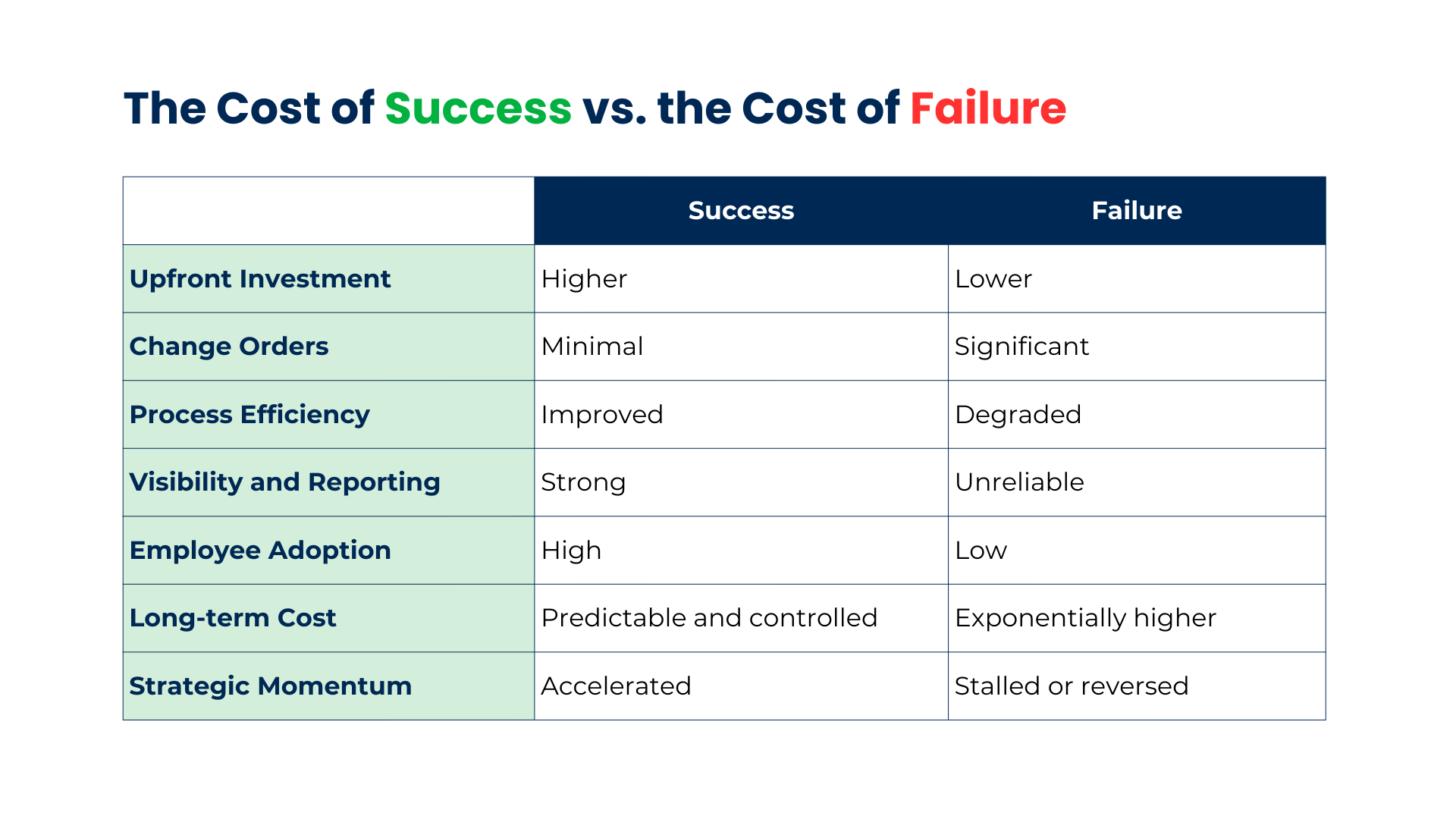
Success requires investment in governance, architecture, testing, change management, and data readiness. Failure costs far more, in dollars, time, and organizational confidence.
So what’s the recipe to Prevent Failure? Build a Solution Architecture Office
One of the most effective tools we deploy is the Solution Architecture Office (SAO). This structure ensures the project stays aligned with the business and that quality remains at the center of every decision.
A strong SAO includes:
1. End-to-End Process Governance- Redesigning workflows, not just configuring software.
2. Vendor Management and Oversight- Setting standards, enforcing quality, and holding partners accountable.
3. Quality Assurance Across the Entire Lifecycle- Ensuring that every design, build, and test aligns to business needs.
4. Data Readiness and Ongoing Quality Controls- Confirming that the foundation, data, is clean, structured, and reliable.
5. Organizational Change Management (OCM)- Preparing teams, aligning leadership, training users, and driving adoption.
6. Architecture Blueprinting and Integration Planning- Ensuring all systems talk to each other and support future growth.
7. Testing Frameworks That Validate End-to-End Scenarios- Not just unit testing, but real business process validation.
Investing in these capabilities upfront is a fraction of the cost of repairing a failed implementation. The ROI is measured in operational efficiency, employee adoption, and leadership confidence.
The Bottom Line
Failed software implementations do not fail because companies choose the wrong system. They fail because the organization does not have the structure, governance, or expertise required to implement it correctly. When done right, software implementations unlock efficiency, reduce manual work, improve reporting, and create a foundation for digital transformation. When done wrong, they drain resources, damage culture, and limit growth.
At ethree solutions, we have spent more than a decade helping organizations navigate complex digital transformations, and we’ve seen countless companies spend hundreds of thousands, or even millions, recovering from failures that could have been prevented with the right structure, governance, and oversight.
Success isn’t about picking the right software; it’s about building the right foundation. Governance, process clarity, executive engagement, and data readiness matter far more than any feature set. That’s why we deploy frameworks like the Solution Architecture Office to ensure projects stay aligned, quality is maintained, and adoption thrives.
If your organization is about to start a software project, or you suspect one is slipping, now is the time to act. Bringing in the right expertise early can save your company not just money, but time, trust, and momentum.
Ready to protect your investment, empower your teams, and ensure your next software project drives real business value? Contact us today to schedule a consultation with our experts at ethree solutions. Let’s make sure your project succeeds, on time, on budget, and with the results your organization deserves.
Francisco Venta
francisco@ethree.solutions
Schedule a Meeting: https://bit.ly/3Yg9Kts